
(par 3. 3.1) The Hydrological Cycle
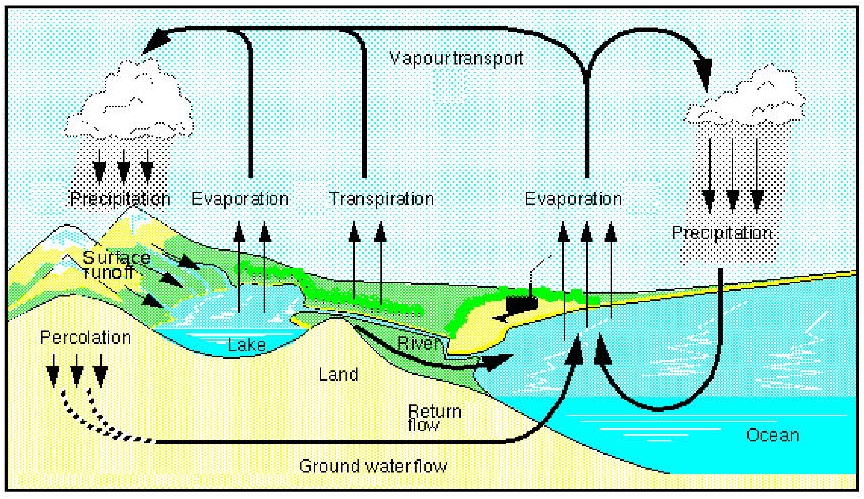
The Hydrological Cycle (also known as the water cycle) is the journey water takes as it circulates from the land to the sky and back again. http://www.euwfd.com/html/hydrological_cycle.html The sun’s heat provides energy to evaporate water from the earth’s surface (oceans, lakes, etc.). Plants also lose water to the air – this is called transpiration. The water […]
(par 3. 3.1) Description of the Hydrologic Cycle
http://www.nwrfc.noaa.gov/info/water_cycle/hydrology.cgi This is an education module about the movement of water on the planet Earth. The module includes a discussion of water movement in the United States, and it also provides specific information about water movement in Oregon. The scientific discipline in the field of physical geography that deals with the water cycle is called […]
(par 3. 3 ) Sedimentary and biological cycles – keeping nature circulated

In Nature everything is circulated. The two broad categories of global cycles are sedimentary and biological. A short but insightful article. http://www.libraryindex.com/pages/3191/Biogeochemical-Cycles.html The chemical elements that compose the Earth are not held in static compartments. The components of the atmosphere and oceans are transported by the fluid movements of these bodies, which determine our daily […]